Virtual Assistant Tasks: The Complete List for 2026
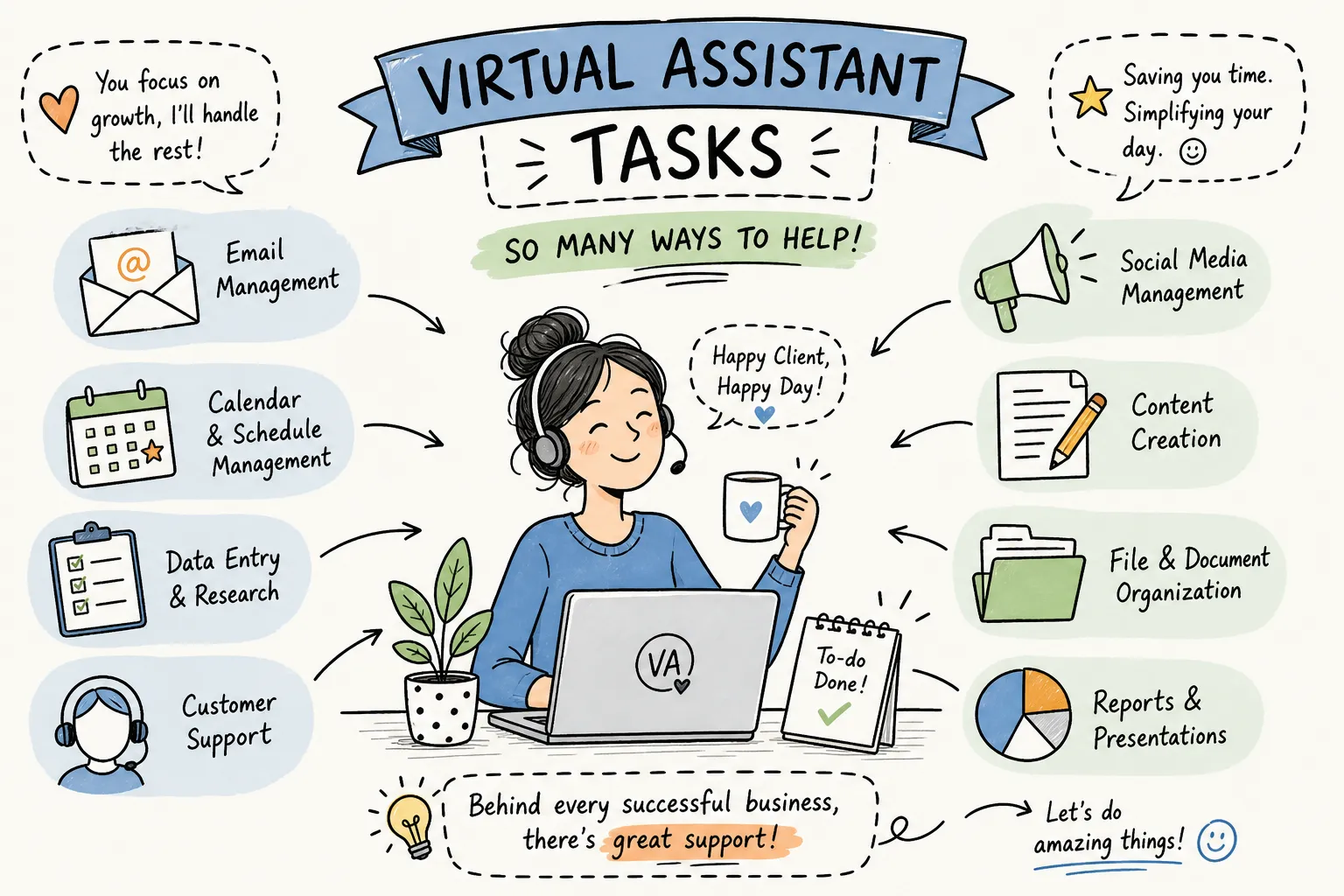 Virtual assistant tasks can remove a significant share of recurring work from your plate, far more than most business owners expect. If you tracked every task you handled last week, the odds are good that a trained VA could take a large portion of that list off your hands quickly. The problem isn't that owners don't know delegation is possible; it's that they underestimate how wide the scope actually goes. Most people picture a VA answering emails. The reality is that VA responsibilities now cover a wide range of functions, from Zapier automation setup to Meta Ads management to full bookkeeping reconciliation.
This isn't a generic "VAs handle admin" overview. This is a category-by-category breakdown of virtual assistant tasks so you can see exactly what's delegatable, identify which items are costing you the most hours, and build a working plan to hand them off. Services like Delegate and Grow operate across all three major task categories (admin, marketing, and finance), which means one partner can cover what most owners are currently splitting across multiple freelancers.
Below you'll find the full task breakdown, a prioritization framework, clear delegation limits, and a practical guide to turning your task list into a VA job description you can actually use.
Admin virtual assistant tasks that drain the most owner hours
Virtual admin tasks are the most common starting point for delegation, and for good reason. They're frequent, process-driven, and almost never require your judgment. These are the VA responsibilities that eat hours every week while keeping you from work that actually moves revenue.
Managing your inbox and calendar without losing your mind
Email management goes far beyond "checking messages." A skilled VA handles inbox filtering and labeling, drafts routine replies using approved templates, archives completed threads, unsubscribes from irrelevant lists, and maintains an inbox-zero system on your behalf. The calendar side covers booking meetings across time zones, sending reminders, resolving conflicts, and protecting your focus blocks from getting eaten by low-priority calls. Together, these two tasks alone can reclaim several meaningful hours per week for most owners.
Data entry, CRM updates, and file organization
This is often the first thing that slips when founders get busy, and the downstream consequences hit sales follow-up hard. A VA keeps customer records current in your CRM, enters new leads, updates deal stages, maintains spreadsheets, and organizes your cloud file system so nothing gets buried. Accurate CRM data means your pipeline reflects reality, which directly affects how well you can forecast and close.
Automation setup and ops task handling
Some VA services go a step further and build the systems so the work doesn't just transfer, it gets eliminated. Full-service providers can include Zapier workflow creation, trigger-based task routing, and basic process documentation in their admin ops offering. The goal isn't to hand off a task indefinitely; it's to automate it where possible so the same work stops landing on anyone's plate.
Marketing virtual assistant tasks a skilled VA can own
This is where most owners are surprised. Virtual assistant tasks extend well into marketing. Social media, email campaigns, SEO, and even paid ads management are all within scope for a skilled VA. The owner sets strategy and gives final approval; the VA handles execution.
Social media scheduling, engagement, and reporting
A VA can manage the full execution layer of your social presence: maintaining the content calendar, scheduling posts on approved platforms, responding to comments and DMs using brand-approved scripts, and tracking performance metrics like reach, engagement rate, and follower growth. You're not handing over brand voice or content strategy; you're handing over the execution work that doesn't require your involvement to get done right.
Email campaigns, newsletters, and list management
Email marketing operations are a strong candidate for delegation. Drafting and formatting campaign content using your approved messaging, scheduling sends, segmenting lists, tracking open and click rates, and managing subscriber hygiene are all tasks a VA can handle independently. What stays with you is the core messaging strategy and any creative direction; the VA makes sure it gets built, formatted, and out the door on time.
SEO, website updates, and paid ads management
This is where the task list expands in ways most owners genuinely don't anticipate. On-page SEO updates, analytics monitoring, content publishing, basic website security checks, and Meta Ads campaign management are all within the scope of a capable VA. Some full-service providers bundle SEO, website management, Meta Ads, and link building, so clients can consolidate work they're currently splitting across multiple freelancers into one partner with one point of contact. That kind of consolidation reduces coordination overhead and simplifies your vendor stack.
Finance and back-office virtual assistant tasks worth handing off
A common misconception is that bookkeeping requires a CPA. It doesn't. There's a clear line between what a bookkeeping VA handles and what a licensed professional handles, and most of the weekly financial admin falls firmly on the VA side of that line.
Invoicing, expense tracking, and payment follow-ups
A bookkeeping VA creates and sends invoices, categorizes expenses, tracks receipts, and follows up on outstanding payments, all without the owner needing to touch a spreadsheet. The VA handles data accuracy and record organization; your CPA handles tax strategy and compliance. Those two roles complement each other. They don't overlap.
Statement reconciliation and financial recordkeeping
Matching transactions to receipts, flagging discrepancies, maintaining clean monthly records, and preparing organized data for your accountant are all tasks that belong on your VA task checklist. The reconciliation work is time-consuming and detail-intensive, but it doesn't require licensed judgment; it requires precision and process, which a good bookkeeping VA delivers consistently.
How to prioritize your VA task list for the biggest time return
Knowing what a VA can do is only half the equation. The other half is deciding where to start. Most owners have more delegation candidates than bandwidth to onboard at once, so the prioritization framework matters.
The delegation matrix: high-effort, low-impact tasks go first
Use a simple four-quadrant logic. High-impact, low-effort tasks stay with you; they're your highest-leverage work. High-impact, high-effort tasks should be planned intentionally and supported, not defaulted to a VA. Low-impact, low-effort tasks can be batched or deferred. The first delegation targets are always low-impact, high-effort tasks, they consume the most time for the least strategic return. Email management, data entry, and social scheduling hit that profile almost universally. These are the virtual assistant duties that free the most hours fastest.
Building your personal VA task checklist in 20 minutes
Run a simple audit: list every recurring task from the past week or two, then mark which ones required your specific judgment or expertise. Everything else is a potential delegation candidate. Group the remaining tasks by category, admin, marketing, finance, and identify which category is costing you the most hours. Start there. A focused handoff in one category, done well, builds the trust and process foundation that makes expanding into other categories much smoother.
Tasks that should never go on a VA's plate
Building trust in delegation also means being clear about the limits. Part of writing a solid virtual assistant job description is defining what the VA does not have access to or authority over, and that boundary should be established during setup, not discovered after a mistake.
Legal, financial authority, and high-stakes decisions
Signing contracts, approving large financial transactions, managing bank account access, making investment decisions, and responding to legal inquiries that require professional judgment all stay with the owner. The rule is straightforward: if the task involves your legal accountability or financial authority, it is not a VA task. No exceptions, regardless of how much you trust the person.
Sensitive data, credentials, and confidential access
Sharing personal login credentials without role-based access controls, managing identifiable patient data without proper safeguards, and making hiring or firing decisions should never land on a VA's task list. A well-structured VA job description defines both what the VA does and what they don't have access to. That boundary is part of the setup process, not a conversation you have after something goes wrong.
Turning your task list into a working VA job description
You've identified the tasks. Now you need something actionable. The goal of a VA job description isn't a formal HR document; it's a clear SOP the VA can follow from day one without constant check-ins from you.
The anatomy of a simple VA job description
Five components cover the essentials:
- Task scope, what the VA does daily and weekly, written as specific actions rather than vague responsibilities.
- Tools and software access needed to complete the work.
- Communication expectations, how you want updates, at what frequency, and through which channels.
- Escalation rules, what decisions the VA makes independently and what gets flagged to you.
- Quality standards, how "done" is defined for each task.
Keep it tight and practical. A VA who can follow a clear SOP on day one is immediately productive.
What to do if you don't want to build it from scratch
Most owners don't have time to write SOPs before they start. That's part of why they need a VA in the first place. Delegate and Grow solves this by matching each client with a vetted assistant suited to their specific task mix, with onboarding built into the process. If your task list spans admin, marketing, or bookkeeping, Delegate and Grow covers all three under one roof, one partner, one point of contact, no freelancer roster to manage.
Start with one category, then build from there
Virtual assistant tasks cover far more ground than most owners expect. From inbox and calendar management to SEO, bookkeeping reconciliation, and paid ads, the scope of what's delegatable in 2026 is wide, and the time return on delegation is real.
The most effective starting point is the audit: list your recurring tasks, identify the high-effort and low-impact ones, and delegate those first. Build the process, confirm it's working, then expand into the next category. That's how delegation compounds over time rather than creating more management work.
When you're ready to delegate without the friction of finding, vetting, and onboarding someone yourself, Delegate and Grow is built for exactly that. You get one partner covering every major task category on this list, admin, marketing, and bookkeeping, so you can start reclaiming your hours without adding more vendors to manage. See how the matching process works and get started with the tasks that are costing you the most time today.